

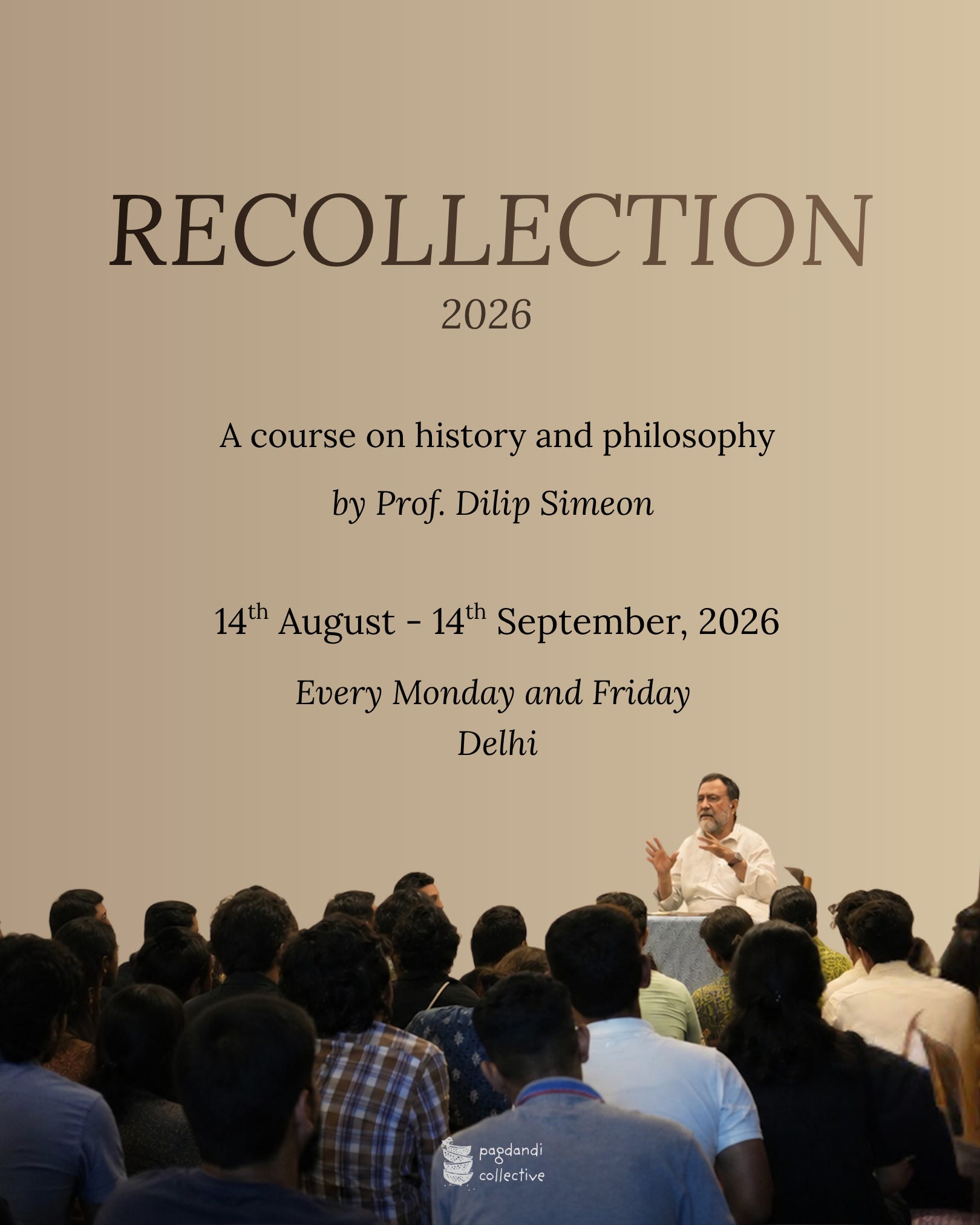
This is the second offering in the Recollection Series. The first Recollection lectures were offered in August 2025.
Prof. Dilip Simeon is a historian and a teacher with five decades of teaching experience. He has taught at Ramjas College (University of Delhi); at Ashoka University; and campuses abroad. His doctoral thesis was on the history of the labour movement of metallurgical workers and miners in Jharkhand. He is the author of the novel, Revolution Highway. Prof Simeon is someone who has engaged with the churn of the radical ideologies of our time, through lived experience as well as academic contemplation. The Recollection 2026 course will engage with important events and ideas of the second half of the 20th CE.
Kindly read the course details below carefully before applying. The last date to apply is 5th July. Apply here.
A Note from the Teacher
The Master said: To study without thinking is futile. To think without studying is dangerous.
Analects of Confucius, II-15
Oh bountiful Gods of the air! Oh Science and Progress!
You great big wonderful world! Oh what have you done?
John Betjeman, ‘1940’
The historical people prefer the hope of the future to the blessing of presence.
Stanley Rosen; Hermeneutics as Politics; p 162
Introduction
In a perceptive observation on the French Revolution and its metamorphosis into tyranny and total war, Marx wrote of Napoleon thus:
He understood that the essence of the modern state was based on the unhampered development of bourgeois society, of private interest… at the same time he still regarded the state as an end in itself and civil life only as a treasurer and his subordinate which must have no will of its own. He perfected the Terror by substituting permanent war for permanent revolution… He fed the egoism of the French nation to complete satiety but demanded also the sacrifice of bourgeois business, enjoyments, wealth, etc., whenever this was required by the political aim of conquest.’ (emphasis added)
The Holy Family; Marx & Engels, Collected Works, vol 4
We live in the shadow of the French Revolution, which ‘perfected the Terror’; and which, appropriately was the time when the word ideology came into vogue as a matter of the scientific inquiry into ideas. Total war never ended, it became permanent. Over the course of a century, the mobilisation of entire societies via ideological doctrines led to the clash, then crisis of empires, the remoulding of world order and the emergence of a new form of tyranny; totalitarianism.
Along with the legacy of the Jacobins and Napoleon, there are overlapping shadows, all too familiar to us. These include the Great War of 1914-1918; Bolshevism, Fascism and Nazism; the second world war, atomic weapons, ongoing genocides; political partitions and the drawing of boundaries; astonishing advances in technology, population growth, global warming, and now artificial intelligence.
What we are faced with is the reification of human creations, discoveries, and activities such as capital, technology, and violence to the point where they have become autonomous, and control us, instead of the other way around. A simple way of describing this problem is to think about the term human resources - the vocabulary which makes us yet another ‘factor of production’.
Resources for what exactly?
The reply to this query is always couched in terms of dream-like categories such as nation-building, progress, development, etc., all those familiar pots of gold at the end of the rainbow. Prophesies about the Day of Judgment, the End of History, the Second Coming; or the Bright Future have come to naught: we are confronted with the evaporation of meaning and the destruction of life. How did we arrive here? Setting aside theories that invoke some law which governs human experience, we can begin by studying that experience itself. This of course is a never-ending task, but embarking upon it is fruitful, and also humbling. Our course is a small step along that journey.
Course Content
We shall survey major developments in the second half of the twentieth century, following the end of the second world war to get a clearer picture of these matters.
The issues to be covered will include the post war settlement; the spread of nation-states; the Chinese Revolution and civil war, Nazi death camps, the atomic bombings in Japan, the partitioning of India, Korea, Palestine, Germany and Vietnam; and the massive relocation of populations. A study of the Cold War will include the Sino-Soviet conflict, the Cuban missile crisis, the Cultural Revolution in China, and the continuing conflicts in the so-called Middle East. We shall also discuss decolonisation and accompanying insurgencies in Malaya, Algeria, Sri Lanka, Afghanistan and Pakistan.
We shall begin with a discussion of the early history of religion in Egypt and the Eastern Mediterranean; with a view to gaining an insight into the prehistory of the ideological pieties of today.
We all know that one month is a short duration to study complex issues in depth, so let us approach them with modest expectations and open minds.
Course Format
This course will consist of in-person, classroom lectures and discussions. There will be ten lectures in total. Each of our sessions will last for two hours with a break; and with additional time for discussion. On the day of the class, we will begin at 9:00 AM and end at 1:00 PM. Each meeting will have two hours of lecture with a break and an hour of additional time for questions and discussion.
There will be preparatory reading to be done before the course begins. In addition, for every class there will be reading material to be covered by the students before attending the class. Each class will build on the previous one, therefore, it is important for participants to attend all the lectures in this course. If you are signing up for this course, please make sure that you are available on all the dates. If not, please let us know.
The course will start on 14th August and end on 14th September, 2026. Classes will be held every Monday and Friday. The schedule of classes is as follows:
Week 1: 14th August, Friday
Week 2: 17th August, Monday; 21st August, Friday
Week 3: 24th August, Monday; 28th August, Friday
Week 4: 31st August, Monday; 4th September, Friday
Week 5: 7th September, Monday; 11th September, Friday
Week 6: 14th September, Monday
The classes will be held in South-Central Delhi. Further details will be shared with selected participants.
Preparation
This is a fairly demanding academic course and requires reading before, during and after the course. It is mandatory to attend the entire course from start to finish. We will share a list of reading material which you will be required to study before the course begins. In addition, there is some reading you need to do before applying for the course, which is mentioned below.
Past Offering
This is the second offering in the Recollection Series. You can read more about the first one, here:
Recollection: The Past as a Mirror

In the rainy month of August, we had the pleasure of hosting Recollection, a course on world history taught by Prof. Dilip Simeon. The course was a part of the ongoing six-month Pagdandi Fellowship. Every Tuesday and Friday, twenty students from across Delhi NCR met at our apartment ashram to sit on grass mats and listen to our teacher. Over eight lectu…
How to Apply
You can apply here. The last date to apply is 5th July.
To apply for the course you have to complete a reflection writing exercise. Do not use any AI tools to complete this exercise. There are no correct answers. You will not be judged on the correct use of language or grammar but rather the content and honesty of your reflection.
Reflection Exercise
Part One
Read one of the following essays:
>> Remembering Hiroshima and Nagasaki
OR
After reading one of the essays above, write a reflection of 250-500 words and submit it in the application form. You can reflect on the experiences or observations from your own life, and share your thought process based on what you understood. Please note that any AI responses will be rejected.
Part Two
Take any world event since 2020 of your choice and reflect on it in light of the essay you read in Part I. Write a reflection of 250-500 words and submit it in the application form. Please note that any AI responses will be rejected.
Costs and Fees
pagdandi collective runs from the gifts (time, money and resources) of its well wishers. It is not run as a commercial business. We will continue to function as long as people feel we should be supported.
This course is offered as a gift. After the completion of the course, you may offer your support in the form of a monetary contribution as per your wish or in whatever form. You can also offer your patronage to help us organise future programs and continue our work.
Organising a course like this typically involves a money cost of Rs 15,000 per person and is made possible due to the time, resources and wisdom contributed by a number of teachers, organisers and volunteers.
We are raising funds for organising this program. If you do not plan to attend this course, consider making a contribution towards organising this course and encourage your friends to do so as well. To do so, you may send a contribution to the UPI number 9310545026 or get in touch with us at pagdandi.collective@gmail.com
FAQs
Will I receive a certificate at the end of this course?
No, this is not a certificate course. We welcome students who are keen to learn and have a curiosity for history and philosophy.Is there a fee to enroll for this course?
No, there is no fee to enroll. The course is offered as a gift. You are welcome to support our work and help us continue offering such programs. At the end of the course, you may offer a gift. You may also become a patron by continuing to support our work in the long term.Can I attend this course online?
No, it is not possible. This course is offered in a physical location in Delhi and face to face interaction is an important part of the program.