

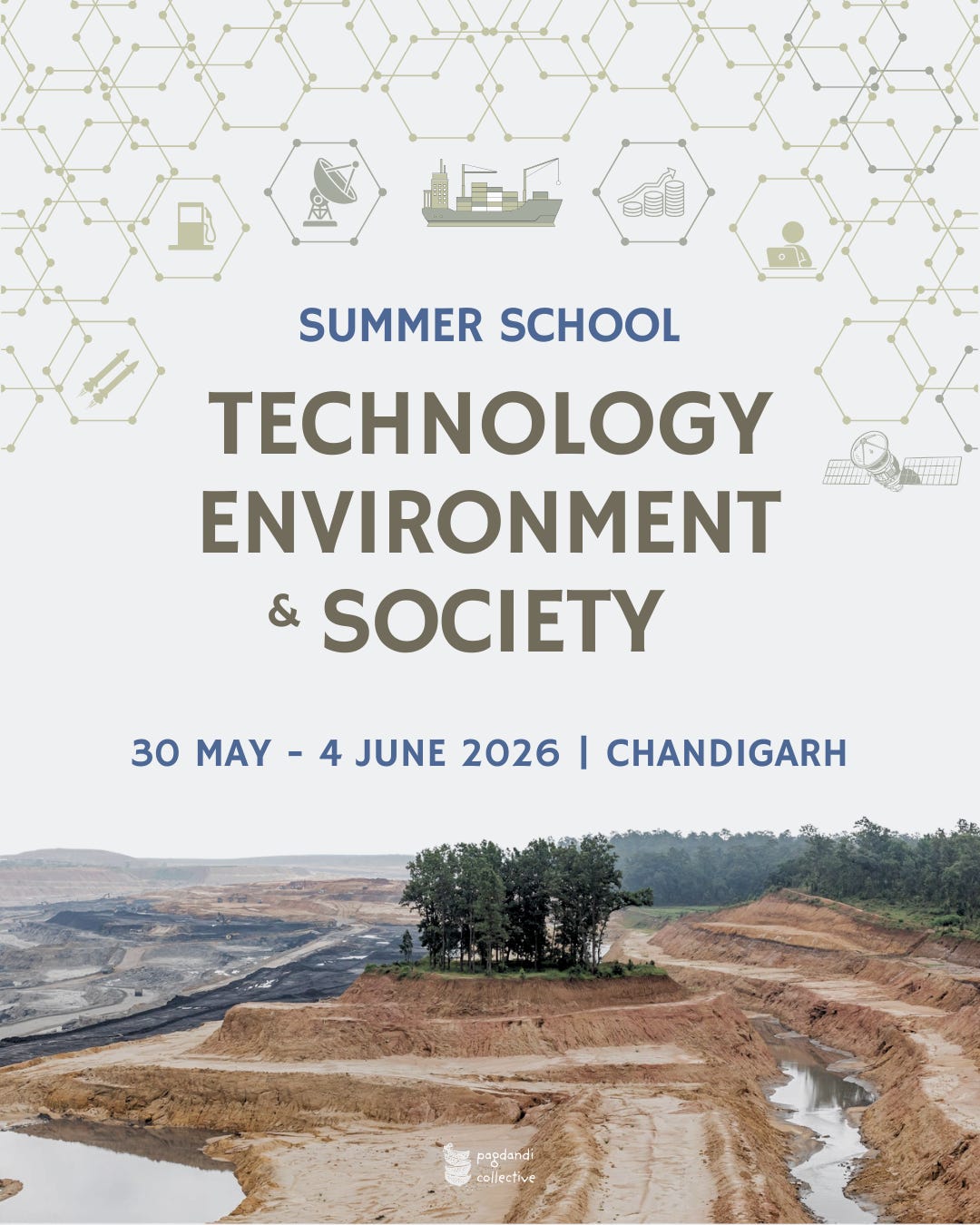
Summer School on Technology, Environment, and Society
From 30th May - 4th June, 2026 in Chandigarh
~Applications are open~
Apply here. Last date to apply is 17th May, 2026.
Context
We live in an era of rapid technological progress. Building on the advancements in electronics and computing, just the last two decades have been marked by the emergence of buzz words like digital payments, internet of things, electric mobility, cloud computing, social media, digital identities, data, and artificial intelligence. These have given rise to new socioeconomic phenomena, from targeted advertising and attention economy to digital arrests and personal data markets.
Parallel to these advances, the last few decades have also seen a trend in the relaxation of environmental regulations in India. Laws from the Forest Conservation Act to the Biological Diversity Act have seen significant amendments to facilitate ease of doing business. The Mines and Minerals (Development and Regulation) Act alone has been amended at least four times since 2015 to expand mining operations across the country. Between 2014 and 2024, over 1.73 lakh hectares of forest land were approved to be diverted by the environmental ministry for development projects across India, with mining, quarrying and hydro-power projects as the leading cause for these diversions.
All these raise important questions for society and the state. How do we weigh the benefits and harms of these rapid changes? How are they shaping individuals and society? How are they influencing our policies? How do changes in technology affect the state of the environment and the conditions of communities? Should people adapt to the incessant demands of technologies or should technologies adapt to the demands of the people? Do we facilitate a deeper penetration of these technologies amongst the people through incentives, or do we check their proliferation and limit them with regulations? What are the checks and balances available in the legal framework? How do communities respond? In times of a global ecological crisis, these may be important questions to ponder upon.
In this program, we will take a closer look at some of these recent developments and explore the deeper philosophical questions that they have thrown up— from the perspective of law, environment, the state and society.
Dates
This summer school will be conducted over the course of six days from 30th May to 4th June, 2026 in Chandigarh. The venue details will be communicated to the participants after selection.
Teachers
The course will be taught by Usha Ramanathan, Debadityo Sinha and Shyam Sundar Sridhar.
Usha Ramanathan works on the jurisprudence of law, poverty and rights. She researches, writes and speaks on issues that include the nature of law, Bhopal Gas Disaster, mass displacement, eminent domain, manual scavenging, civil liberties including the death penalty, criminal law, the environment, judicial process. She has been tracking, and engaging with, the Indian national ID project and has written, and debated extensively, on the subject. She has been writing and debating issues of technology and the human conditions of freedom and liberty for many years. She is currently teaching as a guest faculty at Ashoka University.
Debadityo Sinha is a conservationist with over 15 years of professional experience in issues related to the environment and wildlife protection. He is currently a Senior Resident Fellow and Lead, the Climate & Ecosystems team at Vidhi Center for Legal Policy, Delhi. His research interest lies in the intersection of ecology, law, and policy. In the past, he has worked with organizations like Vikram A. Sarabhai Community Science Centre, Legal Initiative for Forest & Environment, WWF-India, Wildlife Trust of India and several grassroots organizations. He has also initiated litigations in the National Green Tribunal on issues related to environmental clearance, declaration of eco-sensitive zones and compensation for environmental damage.
Shyam Sundar Sridhar is a teacher, researcher and public policy professional. He holds a degree in Development Studies from IIT Madras. He has worked closely with Members of Parliament, co-written a YouTube series on the Indian Constitution, and most recently, led the agriculture, energy, and climate change teams at a global think tank. He has been regularly facilitating courses on the themes of ecology, political economy, and history.
Course Format
The seminars and discussion will be from 3 - 7 PM, punctuated by a tea break. Comprehension of English is required for this course.
This is not a residential program. Participants will be required to arrange their own accommodation in Chandigarh and commute to the venue everyday for the course.
The program is designed for students of law, political science, philosophy, engineering and sciences, as well as for working lawyers, journalists, professionals in the development and public policy sector.
To apply for the program, kindly fill this application form. The last date to apply is 17th May, 2026.
Course Content
Tentative themes to be covered:
Digitisation, Digitalisation, Datafication
Artificial intelligence, Silicon Valley and Big Tech
The Indian experiment: Digital Identities, Aadhaar and its challenges
Citizenship, State and the Constitution
Relationship of Technology and Environment
Developments in Environmental Laws and Regulations
Cost and Fees
The pagdandi collective is run from the gifts (time, money and resources) of its well wishers. It is not run as a commercial business. We will continue to function as long as people feel we should be supported.
This course is offered as a gift from well wishers and those who have attended our programs before. There is no registration fee. After the completion of the course, you may offer your support as Dakshina and also become a patron.
Organising a course like this typically involves a cost of Rs 12,000 per person and is made possible due to the time, resources and wisdom contributed by several teachers and volunteers. If you are unable to attend this course, consider making a contribution towards organising the program. To do so, you may send a contribution to the UPI number 93105 45026 or get in touch with us at pagdandi.collective@gmail.com.